
Scriptural Proclamation
'So shall I have an answer for him who reproaches me, for I trust in Your word. And take not the word of truth utterly out of my mouth, for I have hoped in Your ordinances.' Psalm 119:42–43

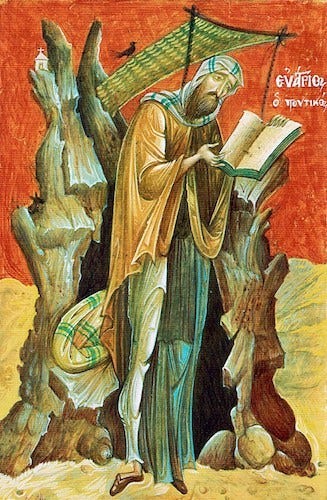
Did you know that one of Evagrius’ most popular works in his time wasn’t on asceticism, nor apophatic prayer, nor theosis… but was a simple list of Bible verses to be proclaimed vocally?
It was called Antirrhētikos, which literally means “talking back.”
At the request of a monk, Evagrius meticulously combed through the Scriptures to pick out specific verses to be vocally repeated in very specific temptations.
For example:
For the “tempting thought that destroys our hope of persevering, claiming that the Lord will never deal mercifully with us throughout the whole course of our lives,” Evagrius prescribes Psalm 40:1: ‘I waited patiently for the Lord; and He inclined to me, and heard my cry.’
For the soul “that is filled with sadness,” he recommends Psalm 42:5: ‘Why are you cast down, O my soul? And why are you disquieted within me? Hope in God, for I shall yet praise Him for the help of His countenance.’
Evagrius associates this practice of repetitively proclaiming a Bible verse with the Psalmist David, and with Christ in His temptation in the wilderness. Christ “handed down” this practice to Christians. He knew that, even though He gave Christians the authority to ‘trample on serpents and scorpions,’ the Christian is often deceived into neglecting this authority. By Christ’s verbal rebuttal of demonic and deceitful thoughts, He was showing us how to use this authority. Even though Christ was physically hungry when Satan tempted Him to use his divine power to turn the stones to bread, He insisted on conforming His human nature to the truths inscribed in the eternal word: that ‘man shall not live by bread alone, but by every word that proceeds from the mouth of the Lord.’
This practice of antirrhēsis (“talking back”) was not unique to Evagrius. It was popular in late antiquity. St Gregory of Nazianzus wrote a similar treatise, listing scriptural verses in eight prayers to proclaim in spiritual warfare. St Gregory of Nyssa’s Anti-Apollinarian Writings also take the form of antirrhēsis.
The practice of scriptural “proclamation” is also promoted explicitly by Origen, who suggests word for word what the vulnerable Christian is to recite in times of testing. He says, for example, to “resist” the demons by proclaiming: “I am not mine, for I have been purchased by the precious blood of Christ and have been made a member of him.”
The practice can also be seen vividly in Athanasius’ Life of Antony and Letter to Marcellinus. Athanasius consistently shows scriptural proclamation to be a way to shake off the gloom and hopelessness that the demons instil in us, raising the mind in hope and faith to where Christ is, in the heavens. Even when surrounded by the treachery of humans, or in actual physical demonic pain (as was St Antony), the proclamation of Scripture disperses all demonic power like smoke, revealing the eternal truth from demonic lies.
Demons operate in the darkness. They have no objective power. The Fathers are insistent that demons have power only insofar as the human being assents to sin. Their throne is built on sin. But when the Christian is raised in Christ to their heavenly place, where Christ is, seated at the right hand of the Father, above all principalities and powers, then they too can proclaim with authority the powerlessness of the demons.
This practice of scriptural proclamation is manifold and deep. It is not a modern invention, but an authentic part of ancient Christian tradition. May we enter into its riches!
I will be putting this idea into greater practice. Thank you mother.
Scripture is food, manna, prayer, medicine, life 🤍 thank you for this. May God be praised.